She Could Be a Cult Leader
[ Part I ]
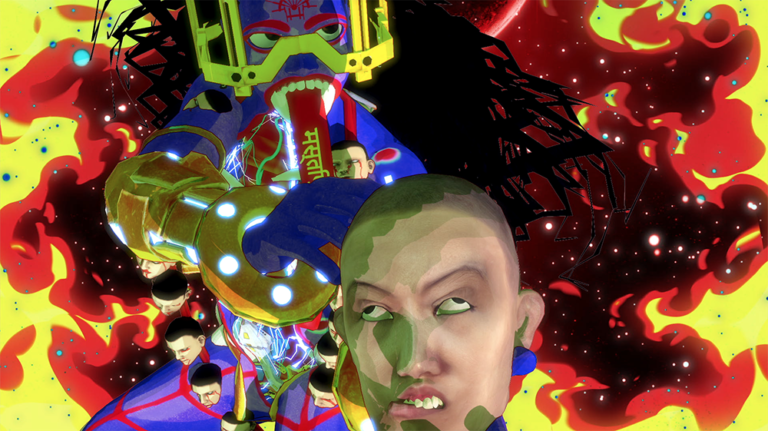
Image from luyang.asia
A revolutionary, an exorcist, a psycho. A goddess, and a demon. She is everything. She comes from the ACG; she bathes in subculture. No matter experimental artist or multimedia artist, these categories are too outdated to define her. Her works on the surface appear light-hearted, absurd, and obviously having fun, but her works connect to something deep and reverberating in the three-dimensional world.
Incessantly rubbing your nerves against the limits of cognition, she is the only one who, if fully understood, could possibly lead her audience on a self-made cult.
She builds a delirious quasi-serious parallel world that leads you into a contemplation on the abyss of death and life.
If you isolate her distinct visual style from all the rest of the complex narrative, you could probably mistake her imageries as from Hell. But quite the opposite, she tells you how not to get there. Throughout her artworks, she interrogates life, life in the biological sense, and what is beyond life. She questions common sense, and resolves to neuroscience and biology for answers to her metaphysical questions.
An art historian who has met extensively many contemporary artists once stated that we are in an age when art at large has run out of originality, but for art to be truly original it has to be cross-pollinated by emergent science or technology. And she is the one who never lets you down in that aspect. If her projects were a perfume, neuroscience, psychology, and biology are underlying themes that are the forever base notes.
Electromagnetic Brainology (2017-18)
Artist Lu Yang created a cult of four deities based on brainology. The basic doctrine of Electromagnetic Brainology is that a person’s life is filled with pain, and that pain is a psychological perception, a subjective feeling relating to neural pathways. The four deities each alleviate one of the four pains in the nervous system, using futuristic medical technologies in the artist’s wild sci-fi-style fantasy. Each deity first strengthens themselves into a super deity by self-stimulation, before they perform healing procedures with modern neuroscientific technologies to relieve people from various psychological symptoms and mental illnesses.
Like Borges, Lu Yang often mixes actual knowledge with fictional knowledge in her sophisticated storytelling. The four deities each represent an element of nature – they are water, earth, fire, and air. This belief is based on Hinduism and Buddhism. The four pains are likened to the four fundamental elements in a metaphoric way. The deities and the technologies they use are more than symbolic make-believes in that they are based on the actual nervous system, brain parts, and neurotransmitters.

Air God launching the Amygdala Electromagnetic Gun. Image from luyang.asia
For instance, through controlling the respiratory center of the central nervous system, with the amygdala electromagnetic gun, the air god alleviates human’s pains arising from air. The amygdala is known for processing fear.

Earth God riding on his mount. Image from luyang.asia
For another instance, the four deities ride on a creature that looks like a flying cerebral peduncle. In Buddhism and Hinduism, it is common for a god to ride on a mythical animal, such as Vishnu whose mount is Garuda the eagle.
The Electromagnetic Brainology is created as a part of a series of creations related to religion, neuroscience, and modern medicine that Lu Yang did from 2010 till present. These realms are much more connected than they appear to an uninformed eye. In neuroscience, there is already literature on religion. Through carefully staged delirium, Lu Yang brings up a philosophical question around what superpower is and whether religion and advanced technology are inherently substitutable, says the artist on her official website.

Earth God stimulating a brain with TMS wand. Image from luyang.asia
On one hand, religion and supernatural powers are part of the oldest set of experiences of human civilization. On the other hand, neuroscience and medicine are emergent, cutting-edge science of modernity. Electromagnetic Brainology demonstrates that the former and the latter are both the beginning and the end of each other, science is the afterlife of religion, and religion is the afterlife of science; they reciprocally complete each other in a non-linear development.

Uterus Man on exhibition, in M. Woods, Beijing, 2018.
Uterus Man - a Man or a Woman?
The shape of the uterus resembles a person holding her arms open. That’s how Lu Yang conceived of the Uterus Man, a superhero riding a chariot made of human pelvic bone.
The uterus is an inherently feminine organ. But superheroes are traditionally men, such as Superman and Batman. To call the hero of uterus by a male name, embeds an irony pointing at the current biases in our society arising from language and the naming of things. As Alessandro de Toni wrote, “he appears to be a man, but the source of his superpowers is the uniquely female reproductive system. This contradictory configuration determines the asexuality, but greatness of Uterus-Man.”
Asexuality can be seen from many points of Lu Yang’s art making and self-concept.
As the behind-the-scene artist, Lu Yang reincarnates herself digitally using CGI technologies, but that digital Lu Yang erases all gender features. Its digital body is also gender-ambiguous. On Lu Yang’s official website luyang.asia, sometimes the artist addresses herself using the male pronouns - he, him and his. I think Lu Yang has a very playful attitude toward gender. She isn’t advocating feminism or presenting herself as an activist, nor is she a transgender (actually, her paintings covertly hint at her heterosexual femininity). Any reader in-depth can find that her reversal of gender in the artwork Uterus Man, as well as her erasure of gender in her digital reincarnations, contains her challenge to the world’s common sense. As default, a child learns genders and genders the world beginning from a young age; as default, a reader of an artwork would first unconsciously identify the protagonist’s gender and demographic information, and form an initial impression of the protagonist based on the demographic information. The initial impression biased by gender will carry on throughout the reader’s appreciation of the work.
In Uterus Man, Lu Yang endows the Man with a masculine name and body proportions, while assigning to him/her female-specific superpowers, such as blood altitude flying, and sanitary pad skate board. Lu Yang uses such ambiguity to provoke people’s unease, and achieve her irony.
In Lu Yang’s Delusional Crime and Punishment, the artist’s self-reincarnation is repetitive and genderless, because she doesn’t want gender to divert her audience’s attention from other priorities that she wishes to express. She always has strong opinions and motifs in her works, and she delivers them just right. As a former psychology major I know too well that the subliminal messages of gender can affect perception. I got it all of a sudden why Kristine Stiles says that truly original art always combines with science and technology - with advancement in science, people advance their understanding of themselves and of others, and with that additional depth of understanding comes new artworks to deliver new messages.

Lu Yang’s Delusional Crime and Punishment on exhibition, M. Woods Museum of Art, Beijing. 2018.
Reference:
Lu Yang’s official website, luyang.asia
This concludes the first part of Lu Yang. In the second part next week, I will analyze the motifs, philosophical questions and contradictions about gender, life, death, and representation in her works.